English
 Spanish

North Star-Rolling Hills Charter Merger Shows What’s Possible When Schools Work for Families
By Alan Gottlieb
Andy Horning wasn’t looking for another school.
As head of school at the K-12 North Star Charter School in Eagle, Idaho, he had his hands full with 1,000 students crammed into a single building. His high schoolers shared hallways with sixth graders, competed for gym time with elementary students, and never quite felt like they were in high school.
Then the leaders of Rolling Hills Public Charter School called.
They had an unexpected proposal. Their K-8 school five miles away in Eagle was losing enrollment. Built for 250, it now held 178. The director, Tara Handy, was retiring. Rather than watch the school spiral toward closure, they wondered: What if North Star absorbed Rolling Hills?
Horning walked through Rolling Hills’ empty cafeteria last February, calculating possibilities. Most observers would have seen a school struggling to stay afloat. He saw a high school campus and a bright future for his students.
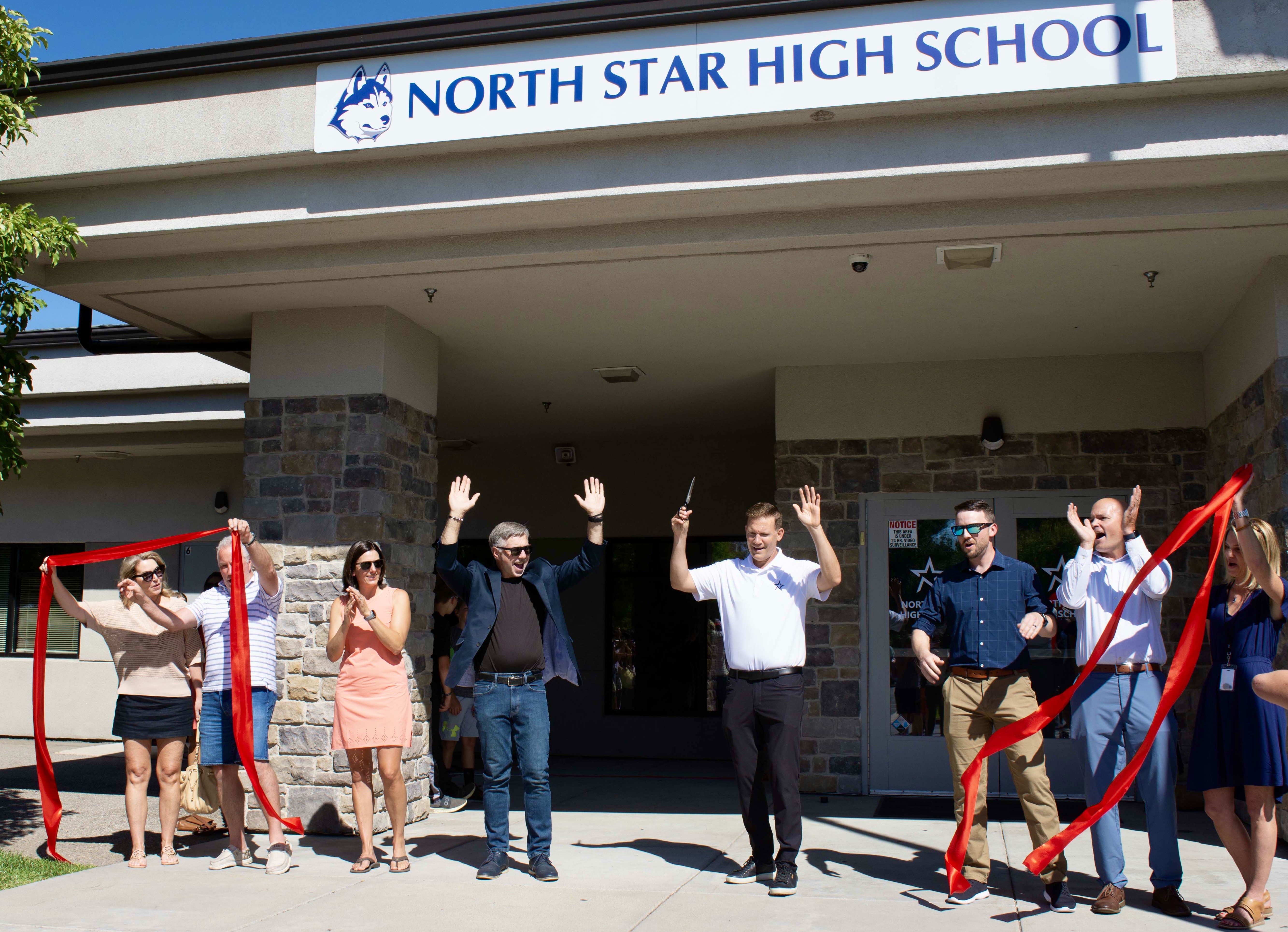
What happened next was unprecedented in Idaho education: two charter schools merged into one. By August, North Star’s high school students were walking through freshly painted hallways at the former Rolling Hills campus, while Rolling Hills students and teachers integrated into North Star’s main campus.
The merger saved one school from closure, gave another room to grow, and created a model that education leaders across the state are now watching.
The crisis
Rolling Hills had been steadily losing students since the Covid-19 pandemic. When Breege Zachary enrolled her daughter in kindergarten years earlier, the school was so popular that families felt lucky to get in.
“We wanted a small school with high academic standards, almost like a free private school education,” said Zachary, who served as board chair during the merger. “We were the best-kept secret.”
But new charter schools kept opening across the Treasure Valley. Parents had options. The school that once turned families away now competed for every enrollment.
The final blow came the week before school started in 2023. Parents who had committed to Rolling Hills suddenly withdrew their children, many heading to a newly opened charter nearby. Instead of the projected 260 students, Rolling Hills opened with 178.
“You can’t make that up in a week,” Zachary said. “If we’d known in June, we could have prepared. But parents play this game all of the time, enrolling in multiple places to find the best option.”
The Rolling Hills board tightened budgets and discussed merging grade levels. Teachers would have to cover multiple grades. Class sizes would shrink further. The board and school leader Handy knew the future looked far from rosy. So, they approached Horning and his board with their unprecedented proposal.
The gamble
Horning faced his own challenges at North Star. The school served more than 1,000 students from kindergarten through 12th grade in a single building in Eagle. The arrangement worked for elementary students but created an identity crisis for teenagers.
Olivia Huyg, now a junior, experienced both schools. She spent sixth grade at Rolling Hills before transferring to North Star for seventh grade. The difference was stark.
“At North Star, the freshmen kind of felt like middle schoolers,” Huyg said. “You couldn’t tell who was a senior versus junior versus sophomore versus freshman.”
The merger proposal seemed to solve both schools’ problems. North Star’s high school would move to Rolling Hills’ building, giving teenagers their own space. Rolling Hills’ younger students would join North Star’s main campus, providing the critical mass needed for robust programs.
But there was no guarantee every Rolling Hills teacher would have a place in the merged school.
The timeline for effectuating the merger was challenging, to put it mildly. Horning started planning in January for an August opening. He needed approval from the state charter commission, funding for renovations, and buy-in from skeptical parents who had specifically chosen small schools for their children.
The Idaho State Charter Commission had never overseen a merger before. Legal questions about asset transfers and debt assumptions required careful navigation. The commission ultimately voted to update North Star’s performance certificate, essentially blessing an arrangement that had no precedent.
The money
The merger might have remained a good idea killed by bad timing if not for crucial funding. Bluum, a nonprofit charter support and advocacy organization, administers federal Charter School Program subgrants in Idaho. Horning approached Bluum in February with the plan to merge two charter schools, create a dedicated high school campus, and save a failing school in the process.
“They really liked this,” Horning said. “This is good for charter schools across the state. Charters helping charters.” “At Bluum we have been talking about the need for mergers as a way to strengthen our public charter school sector for years, but to the credit of the leaders of North Star and Rolling Hills they moved from talk to action,” observed Bluum’s CEO Terry Ryan. “This is what can happen when you focus on doing what’s best for students.”
Through a third-party peer review process, North Star was awarded a subgrant of $800,000 from Idaho’s Building on Success for Future Excellence CSP grant. Then, when additional federal funds became available to Bluum later in the year, they allocated another $1.2 million to the merger.
The $2 million transformed possibilities into reality. The brown carpet and beige walls that Olivia remembered at Rolling Hills gave way to bright colors and modern furniture. Science labs got new chemical-resistant tables. Teachers received height-adjustable desks. The old library became a cafe where students could buy Italian sodas and bagels.
Most importantly, the building began to feel like a high school. Seniors started showing up early to fish in the pond behind the building. Students played spike ball on the expansive green space. The elementary playground was removed and reinstalled at North Star’s main campus.
“This feels more like high school,” Huyg said. “Before, it felt more like an extension of middle school.”
The human cost
Not everyone made the transition. Rolling Hills teachers had to apply for positions at the merged school. North Star needed teachers for new middle school electives but not for every elementary grade.
Mike Friedman, who taught social studies at Rolling Hills, spent spring evenings searching job postings in nearby districts. The uncertainty gnawed at him.
“There was some worry,” Friedman said. “Is it going to be for everybody? Are we all going to be able to move over?”
Friedman interviewed for a new position teaching personal finance to eighth graders. He got the job, along with four other Rolling Hills teachers who successfully transferred. Others found positions elsewhere. One moved to Washington state.
For some parents, the merger meant longer commutes and separated siblings. Families who had chosen Rolling Hills specifically for its walkable neighborhood school now faced 20-minute bus rides. Some who loved having all their children in one building now made multiple drop-offs.
“The convenience factor was an issue for some,” Horning said. “Parents said, ‘My high school kid drives my middle school kids.’ Those were things we had to work through.”
About 15 students chose not to make the transition, less than Horning expected but enough to feel the loss. Some went to traditional public schools. Others tried the new charter that had contributed to Rolling Hills’ decline.
The first days
When school opened in August, the transformation was immediate. North Star’s high school students walked into what felt like their own school for the first time. Different rules applied here: students could use phones in hallways, carry backpacks, and operate under expectations designed for young adults rather than children.
The elementary and middle school students at the main campus discovered new opportunities. Rolling Hills students who had been in a single second grade class of 14 now joined a grade level with three classes totaling 84 students, providing the critical mass needed for differentiated instruction. New electives appeared: STEM for seventh graders, personal finance for eighth graders, study skills for sixth graders.
The Rolling Hills students who transferred brought their own traditions. North Star adopted elements of Rolling Hills’ anti-bullying programs. Teachers shared strategies that had worked in smaller classrooms.
The future
By October of this year, patterns had emerged. Seniors gathered by the pond each morning before school. Freshmen learned to navigate a building that belonged entirely to teenagers. Teachers from both schools formed new teams, sharing strategies across their merged experiences.
For Breege Zachary, whose three children now attend the merged school, the transformation exceeded expectations.
“I can’t believe it all happened as quickly as it did,” she said. “I was thinking it would be a year and a half off.”
The success has attracted attention. Other struggling charter schools in Idaho are watching North Star’s model. Can schools merge rather than close? Can creative consolidation solve enrollment challenges while preserving choice?
Horning believes the answer is yes, with caveats. Success requires an open mind, willing partners, and the courage to move fast when opportunity appears. It also requires money. Without the $2 million federal subgrant, North Star would have opened with old furniture in tired buildings, hoping enthusiasm could overcome aesthetics.
“You’ve got to be willing to take a risk,” Horning said. “You’ve got to be bold.”
On a recent morning, Horning drove between his two campuses, as he does most days. At the high school campus, he watched seniors fishing before first period. At the main campus, he observed middle schoolers adapting to their new identity as the oldest students in the building.
Both schools were thriving. Both were different than before. The merger had created something new: not Rolling Hills, not the old North Star, but a hybrid that preserved what worked while building what was needed.
“This is completely different,” Horning said, standing in the high school’s transformed cafeteria. “The kids are creating the culture of this new school.”
Outside, students sprawled across the lawn, their laughter carrying across the Idaho morning. They were teenagers figuring out who they wanted to become. They were also pioneers in an experiment that might reshape how Idaho thinks about school choice, sustainability, and the courage required to save a failing school by letting it become something else.
“We’re more than a small school now,” Horning said. “We’re showing what’s possible.”
–
Alan Gottlieb is a Colorado-based writer, editor, journalist, communications consultant, and nonprofit entrepreneur who owns Write.Edit.Think, LLC. He founded EdNews Colorado, which later merged with Gotham Schools to form Chalkbeat. He does consulting work for Bluum, an Idaho-based non-profit education group.