English
 Spanish


Idaho’s School-Age Population is Growing. The Warning Signs Are, Too.
By Alan Gottlieb
Idaho ranks first among the 50 states in projected public-school enrollment growth through 2031, third in net migration since 2020, and second in the growth of its child population (See image below).
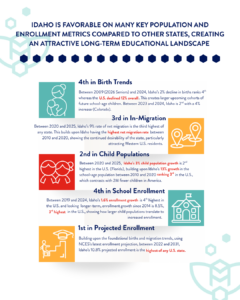
That’s according to a landscape analysis prepared this summer for Bluum, the Boise nonprofit that has spent a decade helping develop the state’s charter sector.
Other western states are shedding children. Idaho remains the exception.
The analysis, produced by Brian Eschbacher, a Denver-based consultant with deep expertise in school enrollment planning, arrived in the middle of the worst enrollment year Idaho’s district-run public schools have recorded in three decades. District-run schools lost 4,361 students in 2025-26. The state’s charter schools, which are public schools too, gained roughly 380 between them, and charter enrollment statewide is up 65 percent since 2016-17.
For anyone hoping to open new schools in Idaho, the robust health of charter school enrollment compared to district-run schools should be an attention-grabber. In theory at least, a state gaining population as steadily as Idaho has been should not be losing students, period.
It suggests that Idaho’s demographic advantage is real, but it’s also borrowed.
Between 2007 and 2024, Idaho’s fertility rate fell from 83 births per 1,000 women of childbearing age to 59, a decline of nearly 30 percent. Total births over the same period fell only about seven percent. What explains the discrepancy?
According to Eschbacher’s data, the number of women of childbearing age living in Idaho grew by roughly a third over that time, and it grew because they moved into the state.
“While women ages 15-44 are having fewer births, the population size of women those ages has increased, which has led to a largely steady number of births over the long term, and even steady increases in recent years,” Eschbacher said in an interview.
The distinction matters because migration and fertility behave differently. Migration is volatile and responds quickly to factors like housing costs and overall cost of living. Fertility moves slowly and rarely reverses.
A state where birth numbers rest on migration carries a different kind of risk than one where numbers rest on fertility, especially when the people relying on those numbers are, as Eschbacher put it, “making 30-year investments” in building and opening schools
Set against its neighbors, Idaho is in an enviable position, according to Eschbacher’s analysis. Births fell 1.9 percent in Idaho between 2009 and 2024. Over the same stretch they fell 6.4 percent in Colorado, 13.4 percent in Utah, 17.3 percent in Oregon, 22.7 percent in Wyoming and 23.7 percent in California.
Nationally, births fell 12 percent. Idaho’s child population has grown almost nine percent since 2015, the strongest showing in the West and among the best in the nation.
Inside Idaho, though, early signs point to challenges ahead. Between 2015 and 2024 the state’s adult population grew 25.5 percent, its under-18 population grew 8.1 percent, and its under-5 population declined about one percent. Kindergarten cohorts are now smaller than every grade above them. Those children reach school age between 2027 and 2031.
 Eschbacher watched the same trends develop in Colorado. He moved to the state in 2011, ran Denver Public Schools’ school choice office, and has since produced versions of this analysis for Utah, Arizona, Nevada and Arkansas.
Colorado provides an instructive example for Idaho. It spent the first two decades of this century absorbing newcomers. That trend has reversed since the pandemics, and districts have spent the past few years deciding how many and which schools to close. The turn came fast. That speed of change is something Eschbacher and other Idaho planners have taken seriously.
Idaho also has something most states lack: a coordinating body with money behind it. Bluum was created in 2013 by the J.A. and Kathryn Albertson Family Foundation to pursue a goal the foundation set that year: 20,000 new high-performing school seats within a decade.
By Bluum’s accounting, more than $100 million in philanthropic financing has gone into the effort since, along with more than $48 million in federal Charter Schools Program money, producing roughly 23,638 seats across 60+ schools. Bluum, led by Terry Ryan, now administers the state’s second federal CSP grant, worth $31 million.
That combination of philanthropy, federal money and a single organization shepherding the effort is what Eschbacher credits for Idaho avoiding, so far, the mistakes he has watched other states make.
Elsewhere, including Colorado, Eschbacher has seen operators flooding cities or quadrants of cities with charter schools with overlapping missions and approaches. The results have often been problematic.
“We have this point in time (in other states) where we’ve got federal Charter School Program money and philanthropy and community demand, and we’re just going to flood the market with new schools,” he said. “But then you worry when the dust settles, can they all complement each other?”
Idaho has tried instead to sequence its growth. In Kuna, southwest of Boise, homebuilding is running well ahead of school construction, and Eschbacher said the planning for new schools is looking a full decade ahead.”
We’re trying to have a pretty detailed plan of we’re going to open this school on this site in this year, and it’s going to complement this school on this site in this year,” he said. “Development plans never go strictly according to plan, but at least it’s trying to be really intentional and not trying to overstep in some areas where there may not be a need.”
Sequencing is one lesson from Colorado. Saturation is another. Saturation, he said, has less to do with how many charter schools share an area than with how many of them have distinct models that families can tell apart.
In fast-growing Far Northeast Denver during his time in the school district, Eschbacher saw too many schools offering similar, college-prep-for-all models open in close proximity to one another. Some of them struggled to meet enrollment goals.
Idaho’s charter schools remain unusually varied: classical academies, career and technical programs, Montessori schools, and in Boise a couple of politically progressive schools operating in one of the country’s most conservative states.
All of which returns to the 4,361 students who left Idaho’s district-run schools this year, and to a puzzle the analysis does not solve. Charter schools absorbed fewer than one in 10 of the students who left districts.
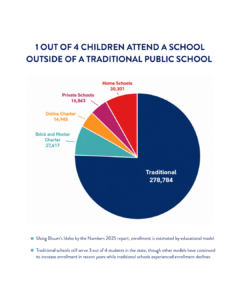
Where the missing students went is unclear, because Idaho does not count them. Roughly one in four Idaho children attends something other than a traditional district school, a category that takes in charters, private schools and homeschooling.
The state likely has the highest homeschooling rate in the country, estimated by Bluum at about 30,000 students which is more than the number of students enrolled in brick-and-mortar charter schools. That 30,000 is a larger number than the enrollment in every Idaho school district except West Ada (See graph below). On top of that there are roughly 18,000 students in private schools. Even the one public option built for homeschooling families, the virtual Idaho Home Learning Academy, lost 374 students last year.
The picture is likely to get muddier before it clears. Idaho’s new parental choice tax credit begins paying out this fall, and its effects are hard to predict. Meanwhile, Eschbacher said he worries less about charter schools in Idaho struggling than the implications if they succeed while the rest of the system does not.
Idaho’s districts operate on some of the lowest per-pupil funding in the country and struggle to pass bonds and levies. They are also barred, Eschbacher said, from the arrangements districts in other states use to secure land from developers as subdivisions go up. The Legislature, meanwhile, has moved steadily toward funding families directly.
“I worry about their ability to make a difference in this really challenging environment,” he said. “Do we end up at some place where Idaho’s stuck?”
Two numbers will show which way Idaho is heading, and neither is the statewide enrollment total. One is net migration, the entire basis of the state’s advantage and the first thing that turned in Colorado. The other is whether the six brick and mortar charter schools opening this fall hit their enrollment targets in their second and third years.
Eschbacher described decline as visible well before it registers. “Schools don’t just drop overnight,” he said. “They go from a long wait list to a short wait list, a short wait list to no wait list, no wait list to declines. And you can see it over a few years.”
Idaho has those few years. Whether it uses them wisely is the question the analysis leaves open.
–
Alan Gottlieb is a Colorado-based writer, editor, journalist, communications consultant, and nonprofit entrepreneur who owns Write.Edit.Think, LLC. He founded EdNews Colorado, which later merged with Gotham Schools to form Chalkbeat. He does consulting work for Bluum, an Idaho-based non-profit education group.