English
 Spanish


Growing Something New: Idaho’s AgriTech Academy
By Alan Gottlieb
When Terry Ryan, the CEO of Bluum, first pitched Sue Lux on the idea of opening an agriculture-focused charter high school in Idaho, she gave him the most honest answer she could.
“Terry, I don’t have a background in agriculture,” she said.
Ryan wasn’t bothered. He told her that wasn’t what he was hiring her for. “We’re hiring you because you have been running successful schools, and we know that you can do it again,” Lux said he told her. “So can you bring on the right people who know the rest?”
The offer was too tempting or her to pass up.
Lux had spent 22 years in alternative charter schools. She started as a teacher, rose to principal, and eventually directed schools across Idaho, Arizona and Louisiana, all within a network called Pathways in Education that served students who had not found a place in the traditional system.
She had crossed paths with Ryan early on, when she was launching a school in Nampa around the same time Bluum was getting off the ground. She had watched his organization grow, admired the teams he assembled, and told herself she wanted to be part of it someday.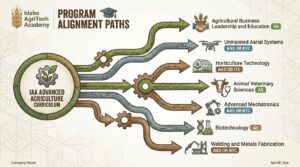
The agriculture idea was not what she had imagined. But the more she dug in, the more sense it made.
Ryan said he saw an immediate fit for Lux in the agribusiness school he envisioned despite her lack of agricultural experience. “Like everything we do, it comes down to having a strong leader,” he said. “And she’s taken off with it. Sue’s awesome. She’s made a ton of great connections in Idaho, in the agribusiness community.”
The Idaho AgriTech Academy will be one of the more unique projects in Bluum’s portfolio. Lux plans to open it in Canyon County in the fall of 2027. It will be Idaho’s first charter high school built entirely around agriculture, technology and business.
Lux is now in the second year of a Bluum New School Fellowship, using the time to study agricultural education models, build industry partnerships, bring on an educator expert in agricultural education, and prepare a charter application—now approved by the state commission.
The concept for the school grew from questions asked by JKAF of Bluum for roughly a decade: Who is going to lead Idaho agriculture into the future? “The idea of some sort of a STEM Agribusiness school came directly from the J.A. and Kathryn Albertson Family Foundation,” shared Ryan.
Agriculture in Idaho has changed dramatically. It is no longer just traditional farming. The industry runs on innovation and technology, from drone systems to self-driving tractors. The skills that future workers will need are not the same ones that serve the current workforce. And there is often a gap between people who are good at farming and people who are good at the business side of agriculture.
The AgriTech Academy is designed to address both problems. Students will receive four years of business training alongside a specialized agricultural pathway in one of several areas: animal sciences, plant sciences, or mechanics, welding and precision agriculture.
“The curriculum is all STEM-based, very heavy science, math,” Lux said. “Every farmer you’ve ever met is a scientist first. It’s funny that we don’t think of it that way, but it’s all science.”
One of the most valuable things she has done during the fellowship is join Leadership Idaho Agriculture, a program that takes participants through the state’s major agricultural regions. Lux has visited dairies, agribusinesses, ranches and factories, met with local government officials, and presented to the governor on agriculture issues.
“That was so eye-opening to me, understanding the challenges and the benefits and meeting like-minded people who are trying to preserve and enhance Idaho ag,” she said. The program also helped her begin building the industry relationships that will be essential for student internships and externships.
She also visited the Global Impact STEM Academy (GISA) in Springfield, Ohio, a school that Ryan worked in the early days of its founding that served as a foundational model. That school is co-located on a college campus, with agriculture and science infused throughout the curriculum. It was, Lux said, the visit that got her brain working on what the Idaho version could look like.
Ryan said that watching GISA grow and flourish since its founding in the mid-2000s is what inspired him to advocate for a similar school in Idaho. “It has been a joy to watch it grow and to see what it’s become. It’s remarkable,” Ryan said.
Over the years, Ryan has taken groups from Idaho to see GISA, and when the leadership of JKAF learned about it, they wanted to know more.
The AgriTech Academy plans to open with grades nine through eleven and a target enrollment of 300 students, adding twelfth grade the second year to reach a capacity of 400. The school will partner closely with the College of Western Idaho, allowing students to pursue certifications and associate’s degrees.
Canyon County still has a significant agricultural presence, but urban sprawl in the Treasure Valley has eroded much of the institutional knowledge that once passed naturally from one generation to the next.
“We don’t have the kids that have that natural understanding and that deep love and some reverence, I would say, for agriculture to protect it, preserve it,” Lux said.
The school expects to attract a mix: kids who grew up on farms or adjacent to farming, and kids drawn to the entrepreneurial and business side. Future Farmers of America (FFA) will be part of the program, and Lux said the leadership skills it develops translate to virtually any career.
Canyon County’s existing school districts all offer agricultural programs, but Lux said the difference is one of emphasis. In a traditional school, agriculture occupies a small corner of the day. At the AgriTech Academy, the model is reversed.
“Instead of fitting a little tiny bit of ag into the day, we’ll fit everything else into the ag platform,” she said. “We’re not developing this in a vacuum. We’re developing this with industry needs in mind and what is missing for the employers, so we can develop those skills for kids to be ready to hit the ground in whatever they choose.”
Lux sees overlap everywhere in the curriculum. English classes would include technical writing for agricultural fields, but also literature rooted in the country’s agrarian history.
“Why wouldn’t they study books like Grapes of Wrath?” she said. “Agriculture really is the backbone of the society. We all need it. We all like to eat.”
A location has not been finalized. Lux said local farmers and developers have offered land at reduced prices, and Bluum is exploring whether a new building could be constructed in time for the fall 2027 opening. The school also needs to be close enough to CWI to make the college partnership practical.
As for the rapid advance of artificial intelligence and its effect on agriculture, Lux said the school is in some ways a direct response to it.
“It is changing farming and agriculture so much,” she said. “We have to teach people how to use these tools. It’s not going to work if they don’t know what’s out there.”
–
Alan Gottlieb is a Colorado-based writer, editor, journalist, communications consultant, and nonprofit entrepreneur who owns Write.Edit.Think, LLC. He founded EdNews Colorado, which later merged with Gotham Schools to form Chalkbeat. He does consulting work for Bluum, an Idaho-based non-profit education group.